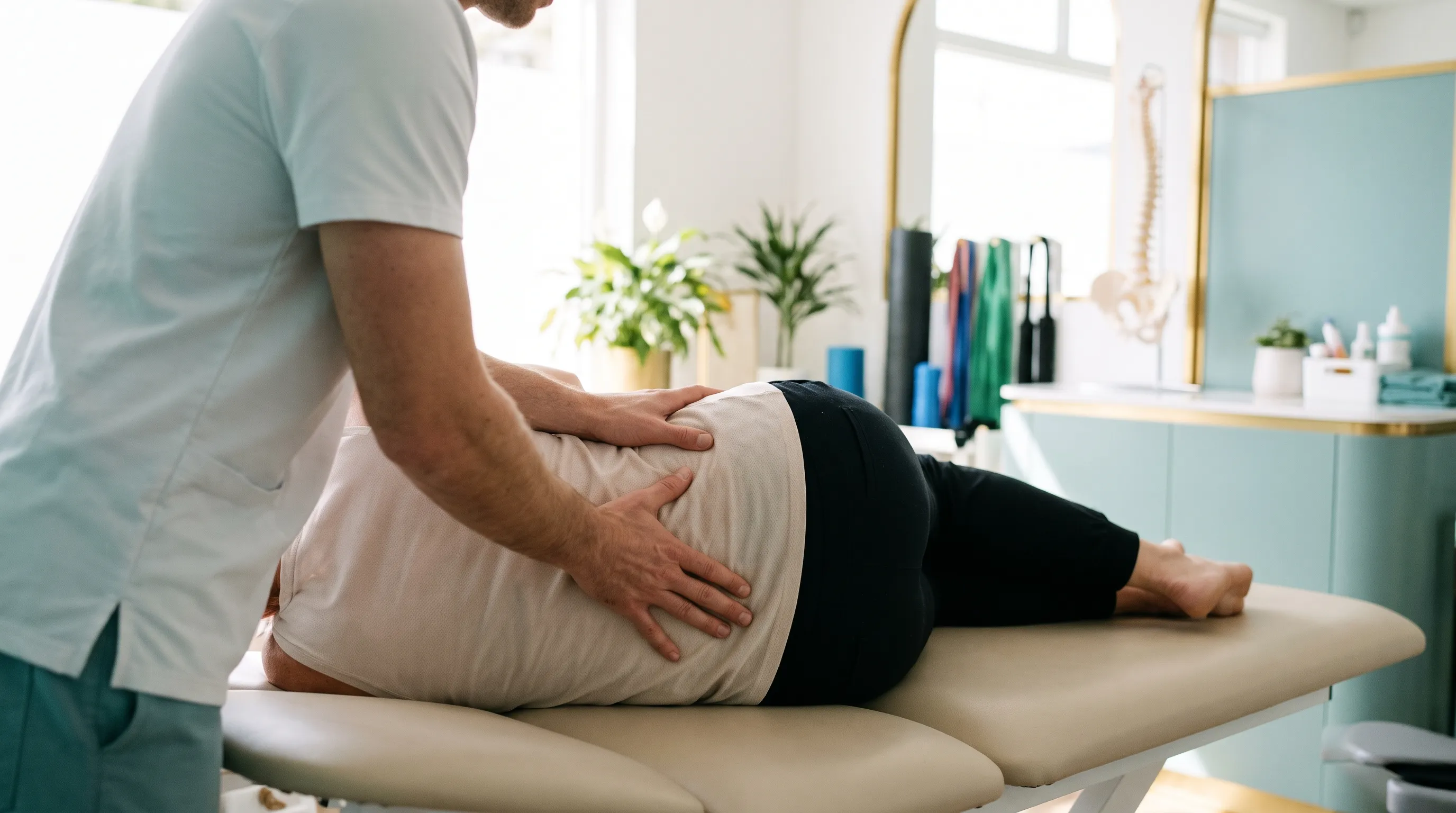
What is a herniated disc?
Between each pair of vertebrae sits an intervertebral disc: a tough outer ring (annulus fibrosus) surrounding a soft, gel-like centre (nucleus pulposus). A herniated disc (spelled herniated disk in the US), also called a slipped, ruptured or prolapsed disc, happens when the outer ring tears and inner material pushes out. If it presses on or inflames a nearby nerve root, it causes pain.
Herniations are most common in the lower back (L4-L5 and L5-S1) and the neck (C5-C6 and C6-C7). Symptoms include:
- Back or neck pain
- Pain radiating down a leg (sciatica) or down an arm
- Numbness, tingling or weakness in the leg, foot, arm or hand
- Pain that worsens with sitting, bending, coughing or sneezing
Many people with disc herniations on MRI have no symptoms at all. The NHS slipped disc page explains the condition in plain language.
Causes and risk factors
Most herniations result from gradual, age-related disc wear (see degenerative disc disease), which makes the annulus more likely to tear with an ordinary movement. Risk factors include:
- Age, most often 30 to 50
- Heavy lifting, repetitive bending and twisting, or prolonged vibration (such as driving)
- Excess body weight
- Smoking, which reduces disc nutrition
- Family history of disc problems
The Mayo Clinic herniated disk overview describes these risk factors in more detail.
Diagnosis: how an MRI guides treatment
A doctor examines your strength, reflexes, sensation and nerve tension signs to find which nerve root is involved. MRI is the best test for a herniated disc. It shows the size and type of herniation (protrusion, extrusion or sequestration), which nerve is affected, and the health of neighbouring discs. X-rays cannot show the disc itself but can reveal alignment problems, instability or other bone causes. CT is used when MRI is not possible.
The MRI findings shape every option, from physiotherapy to surgery to regenerative injections. If you have a scan, you can send your MRI for a doctor review before deciding anything.
Conventional herniated disk treatment
- Activity and physiotherapy. Physical therapy for a herniated disc focuses on graded exercise, movement strategies and core and hip strengthening. Bed rest is not recommended.
- Pain medicines. Anti-inflammatories may help in the short term. The UK NICE guideline NG59 advises against gabapentinoids, oral steroids and benzodiazepines for sciatica.
- Epidural steroid injection. Can reduce nerve inflammation and pain for weeks to months in acute, severe cases. It does not change the disc itself.
- Microdiscectomy. Removes the herniated fragment. It usually relieves leg pain faster than non-surgical care. In the well-known SPORT trials, surgical and non-surgical groups both improved, with surgery giving faster early relief. Re-herniation occurs in a minority of patients.
- Fusion or disc replacement. Reserved for specific situations such as instability or recurrent herniation.
Regenerative options: what the evidence says
Regenerative approaches try to improve the health of the disc and reduce inflammation around the nerve. None is an approved standard treatment for disc herniation in the US, UK or Australia.
- Stem cell therapy: mesenchymal stromal cells (MSCs) from bone marrow, fat or umbilical cord tissue are injected into the disc. Pilot studies and early-phase trials, including an industry-sponsored programme using donor cells, have reported improvements in pain and function for some patients, but results are mixed and placebo-controlled data are limited. See PubMed clinical studies of MSC injection for disc degeneration.
- PRP therapy: platelet-rich plasma injected into the disc or around the nerve root (epidural). Small randomised and observational studies suggest possible pain relief, comparable in some studies to steroid injections. See PubMed studies of PRP for disc pain.
- Exosome therapy: studied in laboratory and animal models of disc degeneration; human evidence is very limited.
Regenerative injections work best in theory for contained herniations and discs that still have height and hydration. They are not designed to remove a large fragment pressing on a nerve.
Comparing herniated disc treatment options
| Option | Best suited to | Evidence | Recovery time | Main downside |
|---|---|---|---|---|
| Physiotherapy and activity | Most new herniations | Strong | Weeks | Slow; needs commitment |
| Epidural steroid injection | Severe nerve pain | Moderate, short term | 1–2 days | Relief may be temporary |
| Microdiscectomy | Persistent leg pain, weakness | Strong | 2–6 weeks | Surgical risks, re-herniation |
| Intradiscal PRP | Contained herniation, disc pain | Early | Days | Not standard; variable |
| Intradiscal MSC (stem cell) | Painful degenerated disc | Early-phase trials | Days to weeks | Experimental; long-term data lacking |
Living with a herniated disc: self-help that matters
While a disc settles, simple habits support recovery:
- Stay active within comfort. Walking is one of the best early exercises; pain that settles within a day is usually not a sign of harm.
- Change position frequently. Long sitting increases pressure on lumbar discs; stand and move every 30 to 45 minutes.
- Lift sensibly. Bend the knees, keep loads close and avoid twisting while lifting.
- Build strength gradually. Core, hip and leg strength reduce load on the spine over time.
- Stop smoking. Smoking reduces blood supply and nutrition to the discs and is linked to slower recovery.
- Sleep comfortably. A pillow between or under the knees often eases night pain.
Keep a simple pain and activity diary. It helps your doctor judge whether you are improving and when further treatment makes sense.
Who may be a candidate?
Regenerative treatment may be discussed if you:
- Have back or leg pain for more than three months despite physiotherapy
- Have an MRI showing a contained herniation or degenerated disc that matches your symptoms
- Have no progressive weakness or red-flag symptoms
- Prefer to explore options before surgery and accept that evidence is still emerging
Who should not have regenerative treatment
- People with cauda equina syndrome or rapidly worsening weakness (urgent surgery is needed)
- Large sequestered fragments causing severe compression
- Severe disc collapse, spinal instability or fracture
- Active infection, cancer, bleeding disorders or pregnancy
- Uncontrolled diabetes or serious heart disease
Risks and side effects
Disc and epidural injections can cause a temporary pain flare, stiffness and soreness for several days. Uncommon risks include disc infection (discitis), bleeding, nerve irritation, headache from a dural puncture, and allergic reactions. Injecting into a disc can, rarely, worsen a herniation. Long-term safety data for cell products in the disc are still limited. Cells used in our programmes are prepared in ISO 9001:2015-certified partner laboratories.
What a herniated disc treatment trip to Bangkok looks like
- Before travel: send your MRI images and report on WhatsApp. A doctor reviews whether a regenerative program is appropriate, or whether you should see a spine surgeon first.
- Day 1: consultation, physical examination and review of imaging; new imaging if your scan is old.
- Day 2 to 4: image-guided procedure according to the protocol, followed by rest and monitoring.
- Following days: follow-up assessment and a physiotherapy plan before you fly.
Most programmes need about 5 to 10 days in Bangkok. Patients travel from Australia, the UK, the US and Canada. See how it works for details. Outcomes cannot be guaranteed.
Recovery and aftercare at home
- Walk daily and avoid heavy lifting and repeated bending for several weeks
- Break up long flights and car journeys with regular walks
- Follow a graded physiotherapy program that builds core and hip strength
- Keep in touch with the medical team on WhatsApp and report new symptoms
- Plan a follow-up review, and possibly repeat MRI, after several months
New leg weakness, numbness around the genitals or bladder changes need urgent local care.
Frequently asked questions
Can a herniated disc heal on its own?
Often, yes. Studies of repeat MRI scans show that many herniated discs, especially large extruded ones, partly shrink or are reabsorbed over months. Symptoms commonly improve within 6 to 12 weeks with activity, exercise and pain control.
What is the difference between a bulging disc and a herniated disc?
A bulging disc extends evenly beyond its normal edge, usually from age-related wear, and is common on scans of people without pain. A herniated disc has a tear in its outer layer that lets inner material push out, which is more likely to press on a nerve.
When is surgery needed for a herniated disc?
Surgery is considered when leg pain stays severe after about 6 to 12 weeks of good non-surgical care, when weakness is getting worse, or urgently for cauda equina syndrome. A microdiscectomy removes the part of the disc pressing on the nerve.
Is stem cell therapy for a herniated disc effective?
Evidence is early. Small studies of cell injections into degenerated discs report reduced pain for some patients, but most lack placebo controls and long-term follow-up. It is considered experimental and is not a replacement for surgery when surgery is clearly needed.
Should I rest in bed with a herniated disc?
No. Guidelines advise against bed rest. Gentle walking, gradually returning to normal activities and guided exercise help recovery more than staying in bed.
How much does herniated disc treatment in Bangkok cost?
It depends on the level and size of the herniation on your MRI and the treatment a doctor recommends. Send your MRI on WhatsApp for a free doctor review and a personalised program.
This page is general information, not medical advice, and does not replace a consultation with your own doctor. Results vary and no treatment outcome can be guaranteed. We are a patient coordination service and may receive a referral fee from partner medical providers. See our medical disclaimer and referral disclosure.