Two different biological approaches
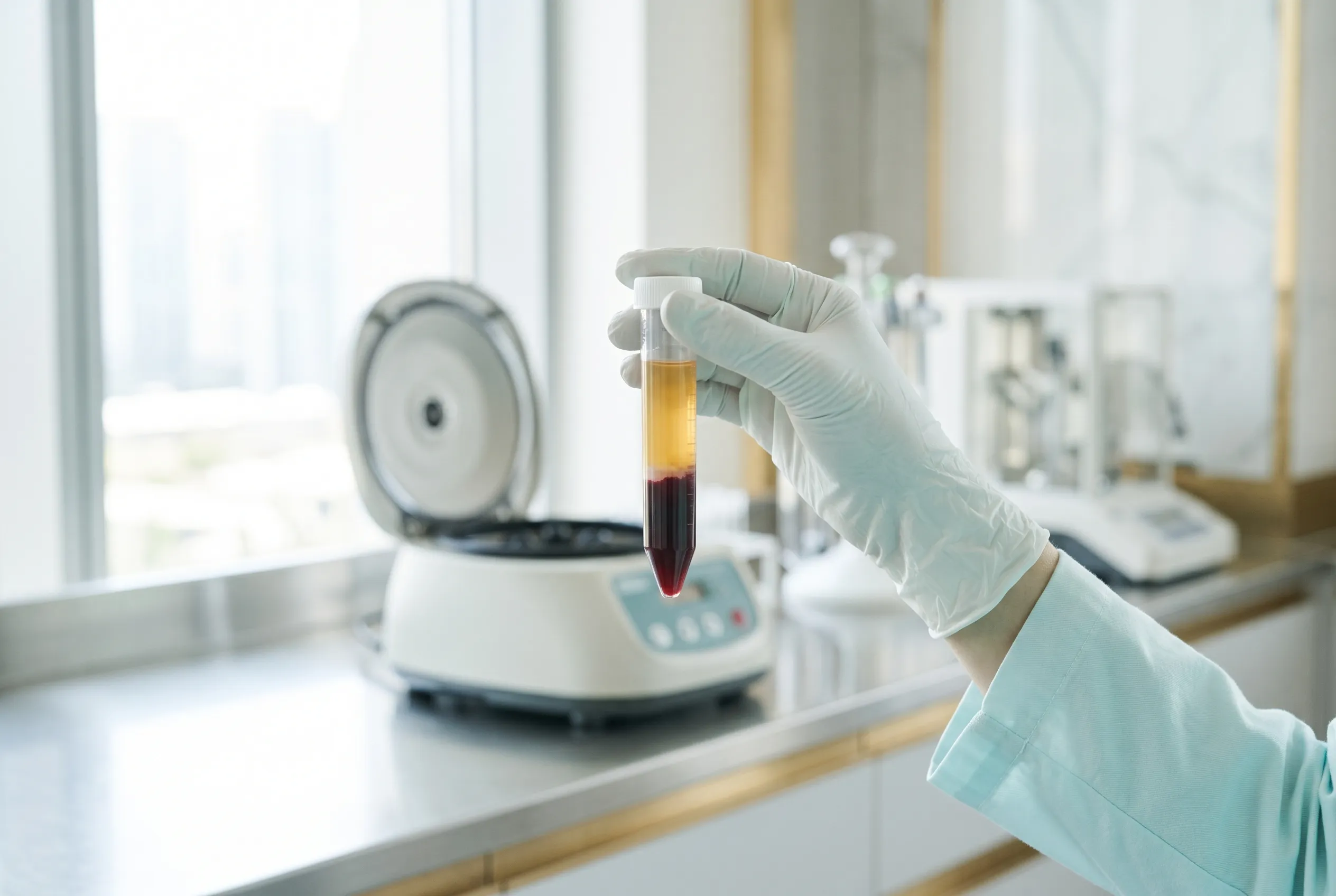
PRP (platelet-rich plasma) is made at the time of treatment from your own blood. It concentrates platelets, which release growth factors over a few days.
Stem cell therapy uses mesenchymal stromal cells, either from your own fat or bone marrow, or from donated umbilical cord tissue processed in a laboratory. These cells release a broader mix of signalling molecules, including anti-inflammatory factors and exosomes.
Side-by-side comparison
| PRP | Stem cells (MSCs) | |
|---|---|---|
| Source | Your own blood | Your fat or bone marrow, or donor umbilical cord tissue |
| Preparation | 20 to 40 minutes, at the clinic | Laboratory processing; culture may take weeks |
| Main action | Growth factor release | Anti-inflammatory and immune-modulating signalling |
| Best-studied uses | Tendon problems, knee osteoarthritis, hair thinning | Knee osteoarthritis; other uses mostly early |
| Typical sessions | 1 to 3 (joints), 3 to 4 (hair) | Often 1 to 2 treatment days |
| Common side effects | Pain flare, swelling | Pain flare, swelling; mild fever after IV |
| Approval in US/UK/AU | Used in practice; NICE says evidence is limited for knee OA | Not approved outside trials |
| Relative cost | Lower | Higher, because of lab processing and testing |
What does the evidence show?
For knee osteoarthritis, both PRP and MSC injections have randomised trials showing pain and function improvements over some comparators, and both have trials showing no clear benefit. Head-to-head trials are few and small. PubMed: PRP vs MSC knee.
For tendon problems like tennis elbow and plantar fasciitis, PRP has more trial data than stem cells.
For spine problems such as herniated disc, both are early-stage options with small studies.
How a doctor chooses between them
Doctors usually consider:
- Stage of degeneration on MRI or X-ray: milder disease is often treated with PRP first.
- Tissue involved: tendons and ligaments versus joint cartilage.
- Previous treatments and how you responded.
- Your goals and timeframe: how many trips you can make, and when you need to be active.
- Medical factors: platelet count, medications and general health.
Risks and side effects
Both treatments commonly cause a temporary pain flare and swelling at the injection site for a few days. Rare risks include infection, bleeding or bruising, and a reaction to local anaesthetic. Stem cell products also depend on laboratory quality, because poorly prepared cells can carry contamination risk, and intravenous use may cause a short-lived fever. The FDA warns about unapproved stem cell products. A doctor should explain these risks before any injection.
When neither may be right
- Severe, end-stage arthritis, where knee replacement may be more effective.
- Pain that is not coming from the joint or tendon shown on imaging, such as referred pain from the spine.
- Active infection, cancer, or bleeding disorders.
- When conventional treatment such as structured physiotherapy has not yet been tried.
Find out which may suit you
Send your MRI or X-ray and reports on WhatsApp. A doctor reviews them and recommends PRP, stem cells, a combination, or conventional care, with an explanation. Cells are prepared in ISO 9001:2015-certified partner laboratories. See also exosomes vs stem cells and how it works.
Related conditions: knee osteoarthritis, rotator cuff tear, hip osteoarthritis.
Frequently asked questions
Is PRP or stem cell better for knees?
Both have been studied for knee osteoarthritis with mixed results. Some trials suggest stem cells may help more in moderate disease, while others find similar outcomes. A doctor's review of your imaging is the best guide.
Can PRP and stem cells be combined?
Yes, some programs combine them, on the idea that platelet growth factors may support the cells. Evidence that the combination is better than either alone is limited.
Which is safer, PRP or stem cells?
Both are generally well tolerated. PRP uses your own blood, so donor-related risks are absent. Stem cell products need careful laboratory testing to reduce contamination risk.
Should I try PRP before stem cells?
For many tendon problems and mild arthritis, PRP is a reasonable first regenerative step. For more advanced degeneration, a doctor may suggest stem cells directly. It depends on your diagnosis.
This page is general information, not medical advice, and does not replace a consultation with your own doctor. Results vary and no treatment outcome can be guaranteed. We are a patient coordination service and may receive a referral fee from partner medical providers. See our medical disclaimer and referral disclosure.