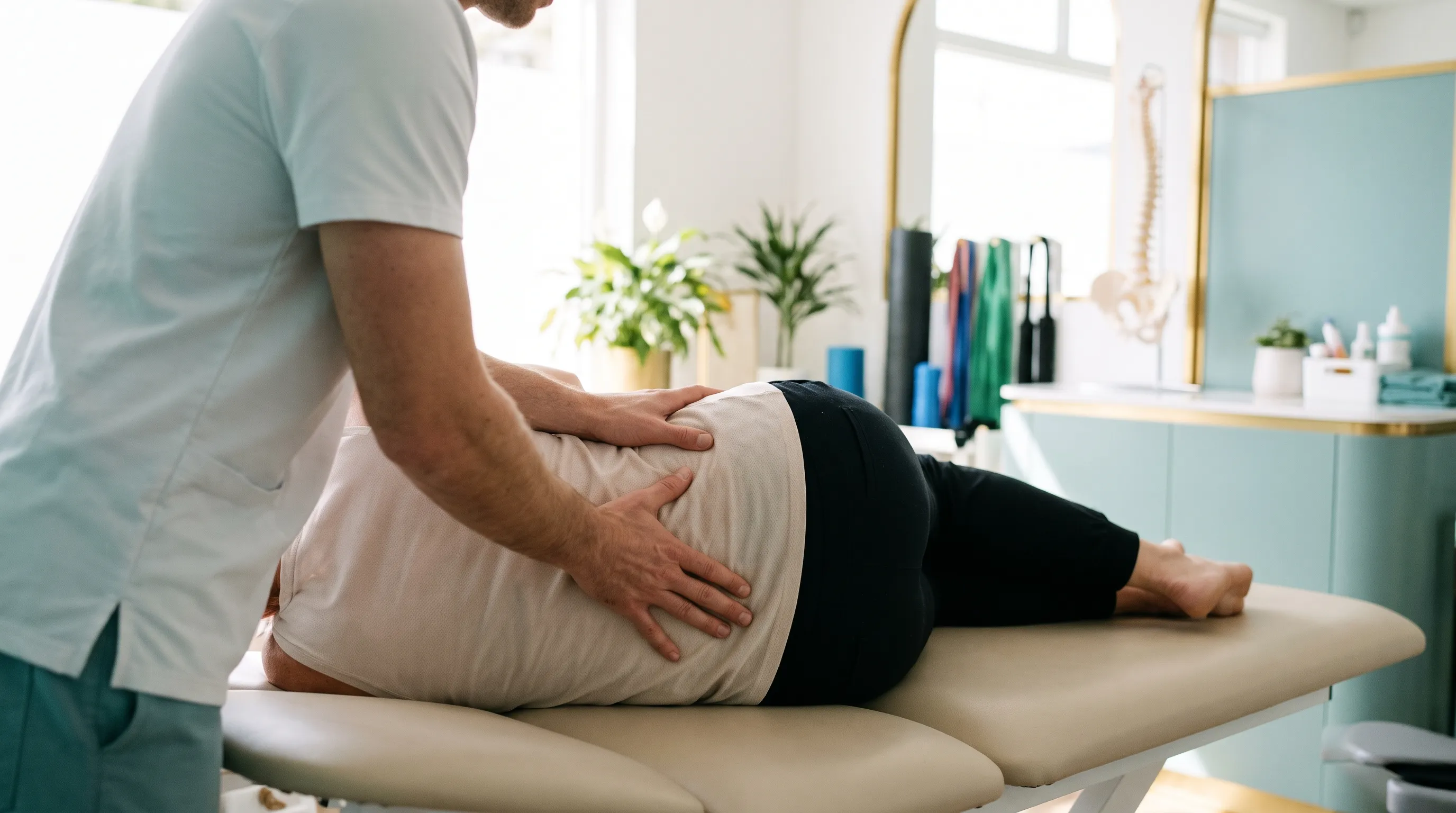
What does “spinal decompression treatment” mean?
The phrase is used for two very different things, which causes a lot of confusion.
- Non-surgical spinal decompression is a form of motorised traction. You lie on a computer-controlled table that gently pulls and relaxes the spine over repeated sessions. It is usually offered by chiropractors and physical therapy clinics for disc-related back pain and sciatica.
- Surgical decompression is an operation that removes bone, ligament or disc material pressing on the spinal cord or nerves. Examples include laminectomy and discectomy. The NHS explains lumbar decompression surgery and who it is for.
Regenerative injections are a third, separate approach that targets the biology of a damaged disc or joint.
How do regenerative injections differ?
Regenerative injections, such as PRP therapy and stem cell therapy, do not stretch the spine or remove tissue. They deliver concentrated platelets or mesenchymal stromal cells into a painful disc, facet joint or surrounding ligaments under imaging guidance. The aim is to reduce inflammation and support the tissue’s own repair processes. This approach is studied mainly in degenerative disc disease and chronic disc-related pain, where results come from small trials (PubMed search of PRP disc trials).
Side-by-side comparison
| Non-surgical decompression (traction table) | Regenerative injections (PRP, stem cells) | Decompression surgery | |
|---|---|---|---|
| What it does | Repeated mechanical traction on the spine | Biological injection into disc, joint or ligament | Removes bone or disc pressing on nerves |
| Typical uses | Disc-related back pain, sciatica | Chronic disc pain, facet joint pain, degenerative disc disease | Severe nerve compression, spinal stenosis, large disc herniation |
| Number of sessions | Usually many over several weeks | Usually one to a few treatment days | One operation |
| Evidence | Weak; NICE advises against traction | Limited; small and early-stage trials | Good for selected patients with nerve compression |
| Invasiveness | None | Guided needle injection | Surgery under anaesthetic |
| Main risks | Temporary soreness; not suitable for some spine conditions | Pain flare, rare infection, rare nerve injury | Infection, bleeding, nerve damage, dural tear |
| Approval (US/UK/AU) | Devices marketed as traction equipment | PRP widely used; cell injections not approved outside trials | Standard care |
What does the evidence say about traction-based decompression?
Systematic reviews of traction for low back pain have generally not found clear benefit compared with other treatments or sham traction (PubMed search of reviews). The UK’s NICE guideline on low back pain and sciatica states: do not offer traction (NICE NG59). Some patients still report short-term relief, and the treatment is low risk for most people, but it has not been shown to change the underlying disc.
What is a non-surgical decompression session like?
You lie on your back or front on a padded table with a harness around the pelvis and chest. A computer controls cycles of pulling and relaxing, usually for 20 to 45 minutes. Courses typically involve many sessions over several weeks, often combined with heat, ice or exercise. The treatment should not be painful; increasing pain is a reason to stop and be reassessed. People with fractures, severe osteoporosis, spinal implants, tumours or spinal instability are usually not suitable.
What is a regenerative spine injection like?
A doctor uses fluoroscopy (live X-ray) or ultrasound to guide a fine needle into the target, such as a disc, facet joint or ligament. Local anaesthetic is used, and some programmes include collecting cells from fat or bone marrow on the same day. Most people go home the same day and are advised to limit heavy lifting for a period afterwards, then return to a guided exercise plan.
What does the evidence say about regenerative spine injections?
Research on PRP and mesenchymal stromal cell injections for disc pain is promising in parts but early. Most studies are small, use different products and doses, and follow patients for a limited time. Some report improved pain and function; others show results similar to comparison treatments. There is no consistent proof that injections restore disc height or reverse degeneration. These treatments should be seen as options for selected patients, not as a replacement for surgery when nerves are seriously compressed.
Who may be a candidate for regenerative spine injections?
- Chronic low back or neck pain linked on MRI to disc degeneration, a contained herniated disc or facet joint arthritis.
- Pain lasting months despite physiotherapy, exercise and standard medicines.
- No severe or progressive nerve compression.
- People who understand the evidence is limited and results vary.
Who should NOT have injections or traction, and needs a surgical opinion?
- Progressive leg weakness or foot drop.
- Loss of bladder or bowel control, or numbness around the genitals or buttocks (possible cauda equina syndrome, a medical emergency).
- Spinal fracture, tumour, infection or significant instability.
- Severe spinal stenosis causing major walking limitation.
- For injections: active infection, active cancer, bleeding disorders, pregnancy or uncontrolled diabetes.
Risks of each option
Traction can cause temporary soreness and is unsuitable for people with fractures, severe osteoporosis or spinal instability. Regenerative spine injections can cause a pain flare; infection of the disc (discitis) and nerve injury are rare but serious, which is why imaging guidance and sterile technique matter. Cells are prepared in ISO 9001:2015-certified partner laboratories. Decompression surgery carries risks including infection, bleeding, nerve damage and, in some cases, ongoing pain. The NHS covers risks of lumbar decompression surgery.
Conventional options come first
Most back pain and sciatica improves with time. The NHS guide to back pain recommends staying active, exercise and pain relief. NICE recommends exercise programmes, manual therapy alongside exercise, and psychological support for persistent pain, with spinal injections or surgery for selected cases. See lower back pain for an overview.
Next step: have your spine MRI reviewed
- Send your spine MRI and reports on WhatsApp.
- A Thai Medical Council-licensed doctor reviews whether your pain fits a regenerative approach or needs a surgical opinion.
- You receive honest, written advice before any travel.
Read how it works, or our guides for patients from Australia, the UK and Canada.
Frequently asked questions
Does non-surgical spinal decompression work?
Evidence is weak. Reviews of traction for low back pain have not shown clear benefit over other treatments, and the UK's NICE guideline advises against offering traction for low back pain with or without sciatica. Some people report short-term relief.
What is the difference between spinal decompression therapy and decompression surgery?
Spinal decompression therapy is a non-surgical traction treatment on a motorised table. Decompression surgery, such as laminectomy or discectomy, physically removes bone or disc material pressing on a nerve. They are completely different treatments with different evidence.
Are stem cells better than spinal decompression?
There is no high-quality head-to-head research. Both have limited evidence for back pain. Stem cell disc injections are experimental and studied in small trials; traction is not recommended by NICE. Surgery has the strongest evidence for severe nerve compression.
Who needs decompression surgery rather than injections?
People with progressive leg weakness, loss of bladder or bowel control, or severe nerve pain from compression that has not settled with conservative care usually need a surgical opinion. Bladder or bowel symptoms are a medical emergency.
Can regenerative injections help a herniated disc?
Most herniated discs improve on their own within weeks to months. PRP and stem cell disc injections are being studied for persistent disc-related pain, but results come from small studies and they are not a proven alternative to surgery for severe nerve compression.
How much does treatment for back pain in Bangkok cost?
It depends on your diagnosis and the program a doctor recommends, so we do not publish fixed prices. Send your spine MRI on WhatsApp for a free doctor review and a personalised program.
This page is general information, not medical advice, and does not replace a consultation with your own doctor. Results vary and no treatment outcome can be guaranteed. We are a patient coordination service and may receive a referral fee from partner medical providers. See our medical disclaimer and referral disclosure.